Last commit 98768a6
Caesar
- Setting
- Roman Empire
- Developer
- Impressions Games
- Publisher
- Self-published (Impressions Games); Sierra On-Line acquired the studio in 1995
David Lester (design) · Simon Bradbury (programming)
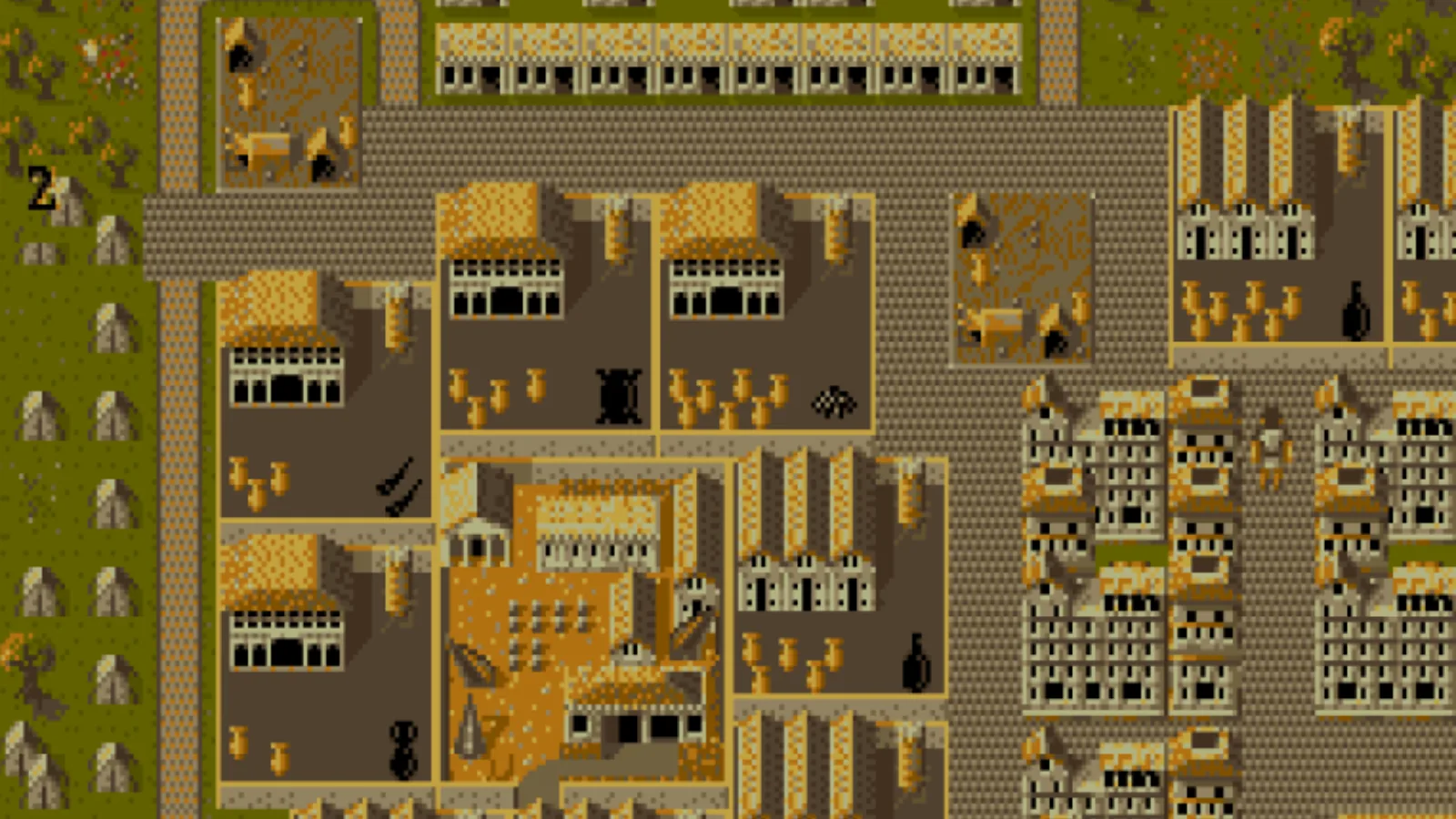
Top-down, pre-isometric — predates the shared SG/.555 pipeline entirely. Its own reverse-engineering problem, not a variant of the others. Amiga first (Oct 12, 1992), DOS/Atari ST/Mac in 1993.
Credits
- Design
- David Lester
- Programming
- Simon Bradbury
- Additional design assistance
- Simon Bradbury
- Graphics
- Jon Baker, Erik Casey
- Sound and music
- Christopher J. Denman
- Research
- Mark Saunders
- Manual
- Christopher Bamford, Christopher J. Foster
- Game testing
- Christopher Bamford, Hosea Battles Jr., Christopher J. Foster, Mark Genovese, Arlon Harris, James Hunter, Lori Kipperman, David Lester, Haywood Nichols, Eric Ouellette, Jennifer Schlickbernd, Scott Woodrick
File formats
Buildings
27 buildings → Every building and structure the toolbar can place, with its footprint in tiles, its price in denarii and the command and tile numbers that name it in the original's executable. Filterable by name or category.Housing
16 rungs → Sixteen grades of house, what each needs to keep its place and to climb to the next, and how many people it holds. The game names none of them.Mechanics
How a city grows → Caesar steps its whole city in 106 steps a month: a hundred one-row passes in which houses climb and fall, then a rebuild of land value, water and every service flag from scratch. Houses react to last month's services, so a city grows about a month behind the buildings that cause it. This is the model under the Housing page: where a house's land value, its needs and its unrest come from. Industry, taxes and the year's accounts → Caesar keeps one purse and settles it once a year. Two taxes (on houses and on workshops) and the army, the plebs and the governor's pay all run on rates the player sets; the month only adds each rate to a running sum, and the year turns the sums into one set of accounts. A workshop's output is a level from 0 to 7, recomputed monthly from a sum of terms, with how well its province suits its goods the largest single one.Production
9 producers → The raw-materials plant and the eight workshops, read out of the original's executable. Caesar measures a workshop by a production level from 0 to 7, not a rate, and the page says how that level is made up.Campaign
19 ranks → The promotion ladder, and the minimum and average ratings each rank demands. Caesar generates its provinces, so the ladder is the campaign.Cheats
1 code → Every documented cheat code, and how to trigger it - save-file byte offsets for the two games that predate any cheat box, and the Ctrl+Alt+C codes the later manuals never mention for the rest.Open-source engines
How to play it today
Every engine above needs a copy of the original game. They ship code, not assets — none of them is a way to play Caesar without owning it.
GOG only, packaged to run under DOSBox. Caesar has never been sold on Steam.
- PCGamingWiki — Caesar ↗ Compatibility notes for the DOS original and the DOSBox re-release.
Tools & Mods
- ModDB — Caesar Tool No mods, files or articles listed as of writing.
Manual
Caesar manual (Impressions, 1993) → Scanned copy, SierraGamers.Community
Shared forums covering the whole series, including Caesar.
GOG's own discussion board, shared across all three Caesar titles since GOG sells them as one series listing.
Covers the whole series in one place. Reddit blocks automated fetches from this machine, so its traffic level wasn't independently checked before adding it — the way MobyGames and a few other sources are handled elsewhere on this site.